

/prod01/prodbucket01/media/durham-university/campaign-sites/melsonby-hoard/MELSONBY_HOARD_637.jpg)
The Melsonby Hoards: rerouting the evidence for vehicles in Iron Age Britain
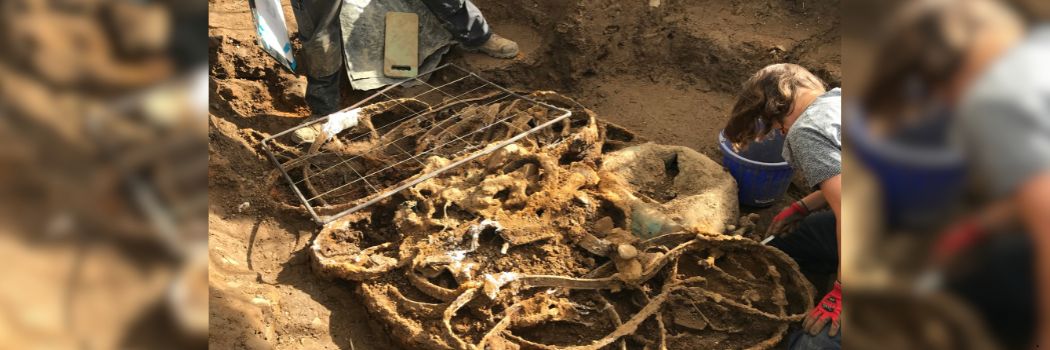
Professor Tom Moore, of our Department of Archaeology, and Dr Sophia Adams, of the British Museum, write about the first overview of the Iron Age find at Melsonby in North Yorkshire.
Our article for “Antiquity” provides the first overview of the Melsonby Hoards, probably the largest deposit of Iron Age metalwork ever encountered in Britain.
Radiocarbon dating confirmed that the hoards were deposited in the Late Iron Age (c. 40BC-AD40), in the decades before the Roman conquest of northern England. They included almost 950 items, comprising a mass of dismantled vehicles, including 28 iron tyres, elaborately decorated horse harness elements, feasting vessels, spears and other objects. These included a large cauldron with beautiful and rare decoration of fish on its base and an unusual form of vessel, decorated with face masks and coral, which was possibly a wine-mixing bowl.
Rethinking aspects of the British Iron Age
The article discusses how the content of the hoard is leading us to rethink aspects of the British Iron Age. In particular, the hoards shed new light on the types of vehicles that existed in Iron Age Britain, with convincing evidence for four-wheeled vehicles, never seen before in Britain, which have affinities with ceremonial wagons from continental Europe. The discovery was made near the Iron Age royal site (or oppidum) at Stanwick, North Yorkshire which was likely to have been the major power centre of the Brigantes and home of the historically attested, Queen Cartimandua. Our interpretation of the hoard suggests that it may be evidence of a major funerary event, perhaps in honour of an ancestor of Cartimandua, and demonstrates the wealth and connections of the communities at Stanwick.
Since publication of the article, the hoards have been acquired by Yorkshire Museum and have moved from Durham to York. We are currently working with the museum to help them develop their first exhibition on the discoveries at Melsonby, which is due to open on 15 May 2026. The exhibition will showcase some of the finds from the hoards and explore some of the possible interpretations for why they were buried.
Research next steps
We have also been developing the next steps for research on the objects, with colleagues at Yorkshire Museum and Historic England, alongside an international cohort of experts, in conservation and materials analysis. There is significant potential to determine the origins of the metal objects in the hoards, analyse the coral that decorates much of the metalwork and refine the dating of the deposition of the hoard. In discussion with the museum, we are also exploring how Hoard 2, which is an enigmatic block of metal artefacts massed together by iron corrosion, can be conserved and displayed for the future. In its current state, still together as the ‘bundle’ of wrapped objects that went into the ground, it is unusual in being able to show the actual act of deposition of a hoard to the public, rather than just its contents. In many ways, we are only at the beginning of conservation, research and analysis of the Melsonby hoards, and it is likely that they will reveal many more important insights in the near future.
The hoards were discovered by metal detectorist Peter Heads, reported to the Portable Antiquities Scheme and excavated in 2022 by a team of archaeologists from Durham University, with support and advice from the British Museum and Historic England. The hoards qualified as Treasure under the Treasure Act 1996 and Treasure (Designation) Order 2002 being comprised of more than two base metal objects of prehistoric date (Iron Age) found in association.
Find out more
-
This blog article was originally published in the Cambridge Core blog. Read the original article.
-
See the latest research paper in the journal “Antiquity”.
-
Read our Melsonby Hoard web pages.
-
Our Department of Archaeology is ranked sixth in the QS World University Rankings by Subject 2025 and fourth in the Complete University Guide 2026. Visit our Archaeology webpages for more information on our undergraduate and postgraduate programmes.