

Staff profile

Biography
Research
My research is motivated by an interest in understanding the relationship between human experience and the state. How do people interact with the state in their daily lives, how do they perceive and conceive of their interactions with the state, and how do they seek to modify the state to suit their purposes? This research has been conducted along three overlapping strands: research into the French royal court with an emphasis on how it was shaped by courtiers, merchants, and financiers; research into peacebuilding after the Wars of Religion and the role of the state within this process; and thirdly research into the relationship between the state and hospitality practices. While my work on the court and peacebuilding has focused on France, my research into hospitality draws on my Japanese language skills to compare hospitality practices in early modern France and Tokugawa Japan.
My current research project, HOST-FJ. Hospitality in Early Modern France and Tokugawa Japan: Concept and Practice, funded by the European Commission through a Marie Skłodowska-Curie Actions (MSCA) global fellowship, seeks to illuminate the crucial functions hospitality fulfilled for the early modern state, in early modern communities, and more generally in early modern people’s lives. It accomplishes this by comparing hospitality, both as a concept and in practice, in early modern France and in Tokugawa Japan — two societies undergoing similar political transformations with the development of stronger, more centralised states after protracted periods of upheaval, conflict, and civil wars. I am particularly interested in hospitality’s role in promoting reconciliation and mending communities after civil conflict, and how the state’s assertion of its monopoly of violence and its greater centralisation altered the way people understood and practiced hospitality. In so doing, the project will emphasise the importance of hospitality to early modern societies beyond questions of charity and the rise of commercial forms of hospitality.
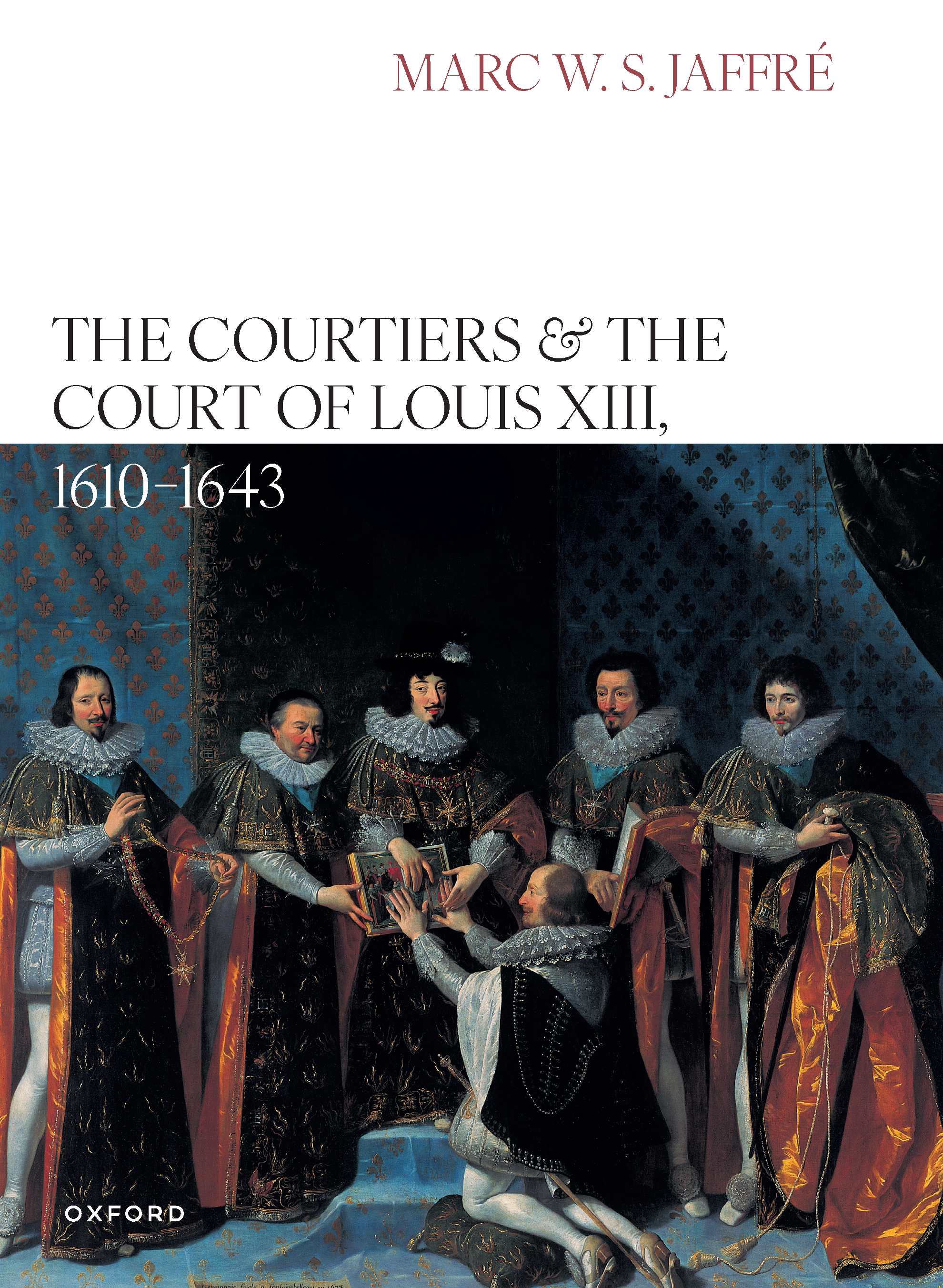
My first book, The Courtiers and the Court of Louis XIII, 1610–1643 (Oxford, 2025), presents the first comprehensive analysis of the royal court of Louis XIII, examining the court from institutional, political, cultural, economic, and military perspectives. The book offers a fresh outlook on the development of royal courts by decentring the monarch and his ministers, emphasising instead the role of courtiers (both low and high ranking), merchants, and financiers in driving this development. In so doing, the book draws attention to individuals’ agency in shaping the institutions of the state and more generally the institutions in which they operate. I have recorded public facing podcasts on this research for Not Just the Tudors and New Books Network.
Aside from the book, my publications on the French court include peer-reviewed articles on people with dwarfism employed at court, on the role of sociability and gender in early modern diplomacy, and on how royal courts functioned in times of civil war. I have also published chapters on Henri IV’s royal printers and on a Tupinambá embassy to Louis XIII’s court, which will appear in Marginalized Voices and Figures in French Festival Culture, c.1550–c.1850 (Brepols, 2027), a book I co-edited with Bram van Leuveren and Alex Robinson.
Through its exploration of court society, the legacy of civil war, and the importance of hospitality, my research asks important questions that remain highly relevant to our society today: how do humans relate to power, how can we mend fractured societies, and how can we welcome foreigners and strangers?
Profile
I am a Marie Skłodowska-Curie (MSCA) global research fellow at the Istituto Storico Italo-Germanico (ISIG) of the Fondazione Bruno Kessler (Italy) and a visiting research fellow at the International Center for Japanese Studies (国際日本文化研究センター, Japan). I am also an honorary fellow of Durham University, a chercheur associé at the Centre Roland Mousnier (Sorbonne Université, France), and a fellow of the Royal Historical Society. I serve as Deputy Chair of the European Branch of the Society for Court Studies and as the book reviews editor for the peer-reviewed journal, The Court Historian.
I have previously held lectureships at Durham University, the University of Oxford (Balliol College), and the University of St Andrews, as well as a postdoctoral research fellowship at the University of Groningen (Netherlands). I hold a PhD from the University of St Andrews, and a MPhil and a MA from the University of Oxford (Merton College).
Research interests
- Early Modern Diplomacy
- Festival Culture
- France c. 1500-1800
- Hospitality
- Marginalization
- Peacebuilding
- Princely Courts
- Tokugawa Japan
- Travel
- Violence
Esteem Indicators
- 2026 - 2029: Global Marie Curie-Skłodowska Actions (MSCA) Research Fellow: HOST-FJ. Hospitality in Early Modern France and Tokugawa Japan: Concept and Practice This project presents a historical investigation into the central role of hospitality in 17th-century France and Japan. Despite many differences, in the 17th century, both France and Japan were undergoing a similar political transformation with the development of a stronger, more centralised state after protracted periods of upheaval, conflict, and civil wars. Comparing ideas of hospitality as well as practice across two societies at a time when memory of civil war was fresh and the state was in a period of reconstruction will shed light on three interrelated questions. How do memories of civil war and inter-community conflict impact on people’s willingness to let others into their home? How did the state’s increasing reliance on forced hospitality for its travels affect the way people understood and practiced hospitality? And what functions did hospitality fulfil in court society at a time of increasing state power? By analysing these problems in concert, this project will interrogate hospitality’s role in promoting reconciliation and mending communities, and how the state’s assertion of its monopoly of violence and its greater centralisation altered the way people understood and practiced hospitality. The project will thus illuminate the crucial functions hospitality fulfilled for the early modern state, in early modern communities, and more generally in early modern people’s lives. In so doing, the project will emphasise the importance of hospitality to early modern societies beyond questions of charity and the rise of commercial forms of hospitality.
- 2025: Book Reviews Editor for The Court Historian:
- 2024: Deputy Chair of the European Branch of the Society for Court Studies:
Publications
Authored book
- The Courtiers and the Court of Louis XIII, 1610–1643Jaffré, M. W. S. (2025). The Courtiers and the Court of Louis XIII, 1610–1643. Oxford University Press. https://doi.org/10.1093/9780198957645.001.0001
Chapter in book
- A Household Affair: Henri iv’s Royal Printers, 1589–1595Jaffré, M. W. (2019). A Household Affair: Henri iv’s Royal Printers, 1589–1595. In A. S. Wilkinson & G. J. Kemp (Eds.), Negotiating Conflict and Controversy in the Early Modern Book World (pp. 217-233). https://doi.org/10.1163/9789004402522_014
Journal Article
- Dwarfism, Institutionalisation and Marginalisation at the Court in Early Bourbon France, 1589–1715Jaffré, M. W. S. (2026). Dwarfism, Institutionalisation and Marginalisation at the Court in Early Bourbon France, 1589–1715. Transactions of the Royal Historical Society. Advance online publication. https://doi.org/10.1017/s0080440126100772
- Sociability and Diplomacy at Louis XIII’s Court, 1610–1643Jaffré, M. W. S. (2026). Sociability and Diplomacy at Louis XIII’s Court, 1610–1643. The English Historical Review, 141(608), 79-109. https://doi.org/10.1093/ehr/ceaf233
- The royal court and civil war at the founding of the Bourbon dynasty, 1589–95Jaffré, M. W. (2017). The royal court and civil war at the founding of the Bourbon dynasty, 1589–95. French History, 31(1). https://doi.org/10.1093/fh/crx003