


Student researchers shine in Energy Day 2026 poster competition
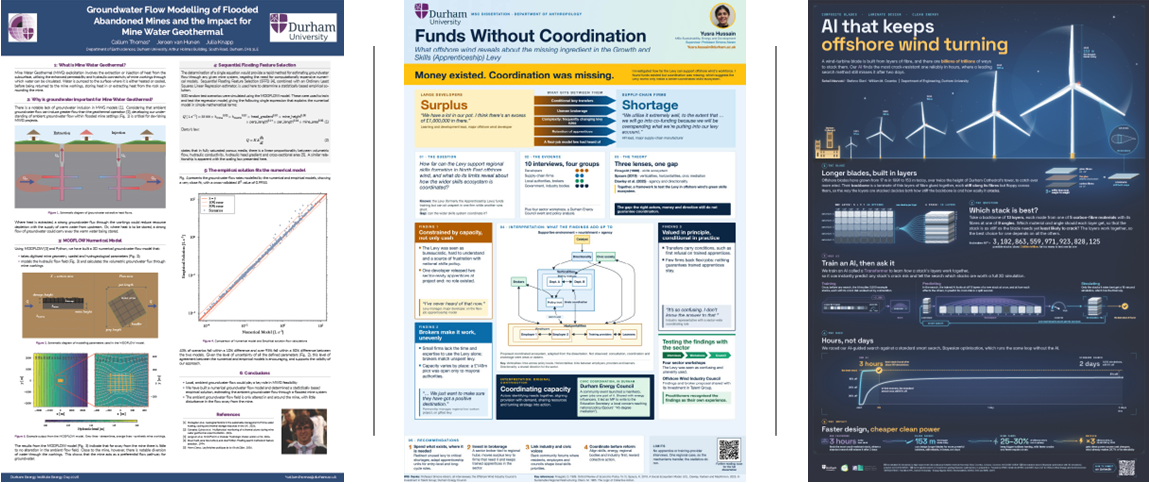
Postgraduate researchers showcased their work and its contribution to a safer and more secure energy future as part of the student poster competition at Energy Day 2026.
Organised by DEI, the competition invited postgraduate students researching energy-related topics to present their work within the context of Energy Day.
Students presented their posters to fellow attendees and judges DEI Co-Director Stuart Jones and Tim Longstaff, Partner at Roland Berger Strategy Consultants. The researchers explained their work and demonstrated how their research connects with the ‘safe and sound’ themes of this year’s Energy Day.
First Place Prize: Yusra Hussain
Yusra Hussain took 1st place for her poster (Middle). Yusra is a PhD researcher in the Department of Anthropology at Durham University, researching the social acceptance of geothermal energy. Yusra previously completed an MSc in Sustainability, Energy and Development in the same department.
Reflecting on her poster and the significance of Energy day, Yusra said:
“My poster draws on my thesis on how the Apprenticeship Levy (now Growth and Skills Levy) works in the North East offshore wind, and what it shows about a just transition: the money existed, but coordination was missing. Presenting it at Redhills, in a place that has lived through an industry ending without a coordinated transition, was a powerful reminder on Energy Day that a just transition and related policies have to be coordinated with communities and learners, not just aimed at them.”
Second Place Prize: Callum Thomas
The 2nd Place Prize was awarded to Callum Thomas’ poster (Left). Callum is a Doctoral Researcher in the Department of Earth Sciences funded by EPSRC via the SCOPE DLA.
Highlighting the importance of his research, Callum said:
“Geothermal energy has the potential to significantly reduce our reliance on centralised energy infrastructure and international supply chains, a big step forward in UK energy security. Mine Water Geothermal specifically, allows former coal mining regions to engage with coal mining heritage, utilising the abandoned mines for low-carbon heat.”
Third Place Prize: Soheil Navvabi
Soheil Navvabi received the 3rd Place Prize for his poster (Right). Soheil is a PhD researcher in the Department of Engineering, funded by EPSRC through the Aura Centre for Doctoral Training in Offshore Wind Energy and the Environment.
Explaining his research, Soheil said:
"Wind turbine blades are built from layers of fibre, and the way those layers are stacked decides how stiff and durable a blade is, yet there are far too many possible stacks to test them all. My research pairs AI with a fast 3D simulation we developed earlier: the AI proposes promising stacks, the simulation checks them, and the best stack is found reliably and far sooner than with a standard search. This could pave the way for larger, more reliable blades and cheaper offshore wind. Energy Day brings researchers together with industry, government and the community, so I designed the poster to tell this story without jargon, and I'm really pleased it resonated with the judges”
Closing Remarks
The poster competition highlighted the breadth and quality of energy research being undertaken by postgraduate researchers at Durham University, and the vital contribution the next generation of researchers is making to addressing energy challenges. DEI would like to congratulate Yusra, Callum and Soheil on their achievements, and thank all students who participated for sharing their innovative research. Their contributions reinforced the importance of bringing together different disciplines, perspectives and generations to help shape a safer, more secure and sustainable energy future.