

Staff profile
| Affiliation |
|---|
| Leverhulme Trust Early Career Fellow in the Department of English Studies |
Biography
Ellie Armon Azoulay ellie.armon@durham.ac.uk
I am a cultural historian, writer, curator, and DJ based in Newcastle upon Tyne whose work listens historically. Through archives of music and photography, public writing, curatorial practice, and collaborative research, I explore how listening produces historical knowledge, sustains collective memory, and creates possibilities for political solidarity across histories of colonialism, migration, and displacement.
My research brings together archives, listening practices, and performance cultures to examine how communities produce and transmit knowledge through music, photography, storytelling, and collective acts of remembrance. I am particularly interested in diasporic communities, music collecting, cultures of protest and resistance, and the ways historical inquiry can be enriched through artistic practice and collaborative forms of knowledge production.
Current Research:
I am currently a Leverhulme Early Career Research Fellow in the Department of English at Durham University, where I am developing my second monograph, Resounding Diasporic Sonic Worlds. This project investigates how music has functioned as a practice of resistance across diverse diasporic communities, including Palestine, Sudan, Algeria, Jamaica, South Asian communities in Britain, and Jewish and Muslim musical traditions in North Africa. Rather than treating music solely as cultural expression, the project explores how listening, performance, and musical practices preserve memory, negotiate displacement, and sustain political and cultural life.
Alongside this research, I am completing my first monograph, Reclaiming the Lore: African American Music Collectors, Refusal, and Anti-Preservationist Possibilities. Emerging from my doctoral research, the book examines African American collecting practices as forms of refusal and community knowledge-making. It centres Black-led institutions—including churches, historically Black colleges and universities, workers' organisations, and musical associations—and argues that collecting was inseparable from performance, pedagogy, and intergenerational cultural transmission. Rather than understanding archives solely as repositories of preservation, the book foregrounds collecting as a living communal practice through which music continually renews relationships between memory, history, and community.
Writing:
Writing is central to my research practice.
Alongside my academic work, I write essays and criticism on music, photography, visual culture, and contemporary politics, bringing historical research into conversation with contemporary artistic practice. My writing explores archives, listening, memory, and the politics of representation across both academic and public audiences.I have contributed essays and criticism to Hyperallergic, Parentheses Review, Artforum, Flash Art, Camera Austria, and Artpress, as well as catalogue essays and artist books.
Across these different forms, I aim to make historical research accessible beyond the university while engaging with urgent questions about culture, politics, and collective memory.
Curatorial Practice:
My research is closely connected to my curatorial practice. As a member of the Programme Committee at the NewBridge Project in Newcastle, I develop exhibitions and public programmes that bring together artists, researchers, archivists, and local communities. In 2025 I curated Resounding Diasporic Sonic Worlds: Archives of Music, Resistance and Community, an exhibition exploring archives as living sites of collective memory and resistance. Bringing together film, photography, sound, and archival projects, the exhibition reflected on contemporary experiences of crisis while presenting archives as practices that challenge histories of colonial and racial violence and imagine alternative futures. https://thenewbridgeproject.com/events/resounding-diasporic-sonic-worlds/
The exhibition featured work by Majazz: Palestinian Sound Archive, Sara Nacer, Christopher Silver, True Form Projects, Nesh Dadgostar, Arthur Larie and Bastien Massa, and Liza Prins and Marie Ilse Bourlanges. As part of the exhibition, I commissioned curator and sound archivist Andrea Zarza Canova to develop a sonic time capsule with participants from the Shieldfield Youth Programme.
Listening Practices:
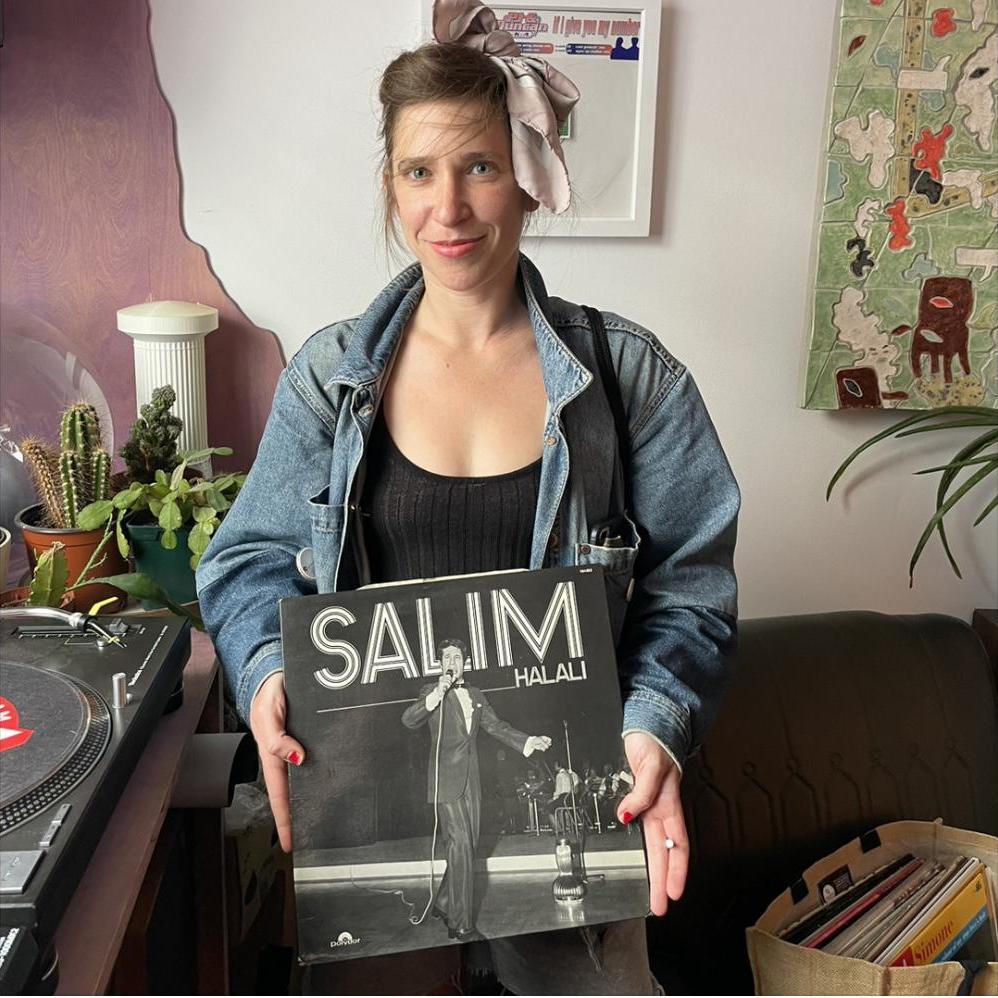
Listening is both the subject of my research and its method. Since 2024 I have curated Diasporic Connections, a monthly vinyl listening programme that brings together music from different places, periods, and genres to explore shared histories of migration, labour, resistance, exile, love, and belonging. The programme regularly invites musicians, collectors, and researchers to share selections from their own collections, opening conversations across diverse listening traditions and diasporic experiences.I also develop listening workshops and collective listening sessions as formats for historical inquiry and public engagement. Grounded in practices of deep listening and decolonial approaches to sound, these sessions create spaces for listening collectively while considering the historical, political, and social conditions in which music is produced, performed, circulated, and remembered. Workshops have been presented at NewBridge Project, Durham University's Special Collections in Berwick-upon-Tweed, the Centre for Sound Environments and Youth Takeover Festival (Lund), and Inter Arts Center (Malmö).
My DJ practice extends these questions beyond academic contexts. Through collaborative listening events, radio broadcasts, and fundraising initiatives, I use music as a form of public history and political solidarity. I have organised and performed at benefit events supporting communities affected by war and ongoing colonial violence, particularly in Palestine and Lebanon, collaborating with grassroots organisations, independent venues, and community radio stations including Radio Alhara (Bethlehem), Slacks Radio (Newcastle), and Lubber Fiend.
Education:
•PhD, American Studies, University of Kent (2021)
•MRes, Exhibition Studies, Central Saint Martins, University of the Arts London (2016)
Selected Publications:
Monograph:
Reclaiming the Lore: African American Music Collectors, Refusal, and Anti-Preservationist Possibilities. (In preparation.)
Journal Articles:
Ellie Armon Azoulay, "The Practice of Refusal in Willis Laurence James's Song Collecting." Comparative American Studies: An International Journal, vol. 18, no. 3, 2021, pp. 355–379. https://doi.org/10.1080/14775700.2021.2003136
Book Chapters:
Ellie Armon Azoulay,, Emily Brady, and Olivia Wright. "Dialogue: Multimedia-Informed Pedagogies and Academic Precarity in American Studies." In Teaching American Studies in Britain: Perspectives and Possibilities, edited by Megan Hunt and Lydia Plath. Edinburgh University Press, forthcoming 2026.
Ellie Armon Azoulay, "'I Sing Them Back to the People Until They Tell Me That I Can Sing Them Just Like Them': Zora Neale Hurston's 1939 Jacksonville Music Session." In Hurston in Context. Cambridge University Press, forthcoming.
Essays and Public Writing:
Ellie Armon Azoulay, "The Soundscape of Genocide in Gaza." Hyperallergic, 2025.https://hyperallergic.com/the-soundscape-of-genocide-in-gaza/
Ellie Armon Azoulay, "Silver Dagger: How Songs Wait for Us – Queer Listening and Memory." Parentheses Review, 2026. https://www.parenthesesreview.com/essays/silver-dagger
Reviews:
Ellie Armon Azoulay, Review of Scripting Empire: Broadcasting, the BBC and the Black Atlantic, by James Procter. ARIEL: A Review of International English Literature. Forthcoming.