

Staff profile
| Affiliation |
|---|
| Professor in the Department of Anthropology |
Biography
I am a Professor of Political Anthropology in Durham University, Fellow of the Royal Society of Arts (FRSA), Co-Director of Institute of Advanced Study (2021-2027) and recipient of the 2025 Rivers Memorial Medal. The Medal is awarded by the Royal Anthropological Institute for outstanding contributions to anthropology, with an emphasis on fieldwork and a significant body of theoretical literature.
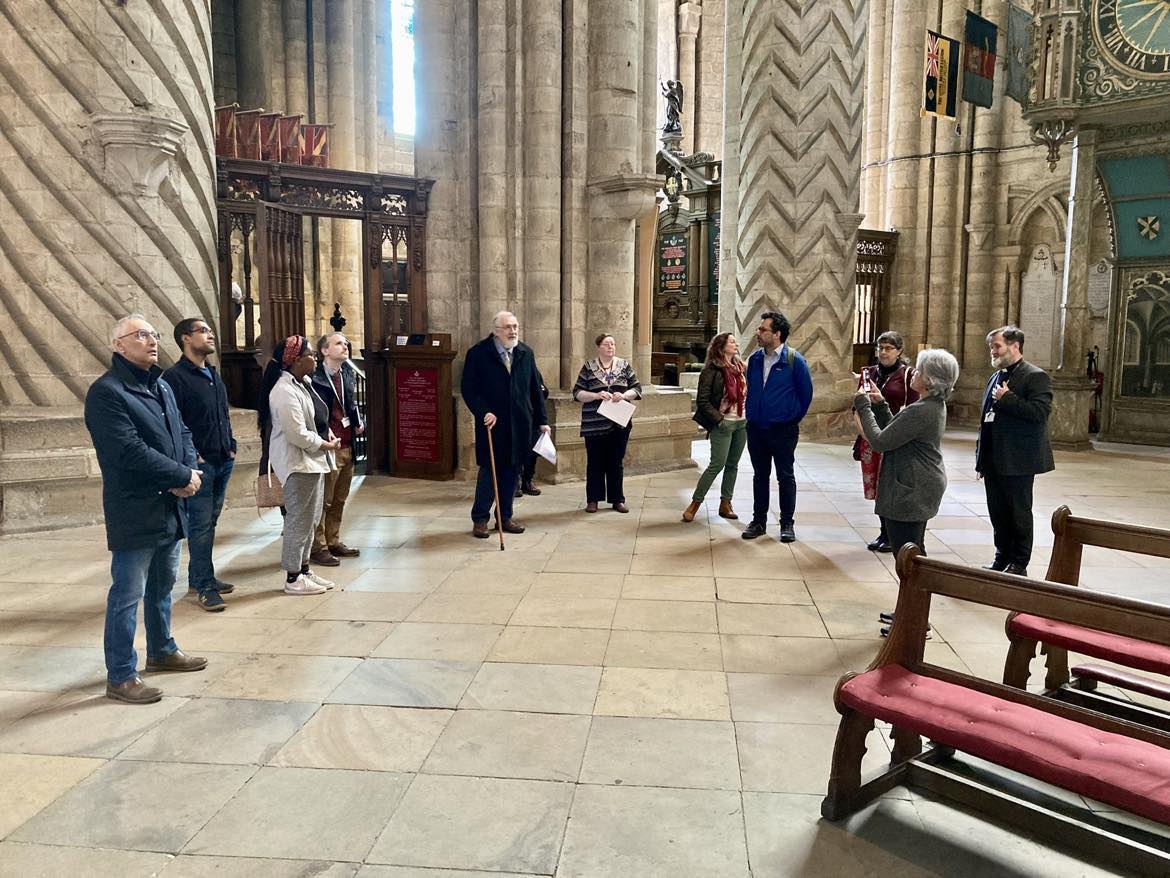
I ethnographically explore how violent pasts are evoked and memorialised through an examination of gendered violence during conflicts, war crimes tribunals, irreconciliation and transnational adoption. I suggest ethical ways of documenting these narratives through a graphic novel and animation film. I also engage with archival, visual and literary sources. I have published extensively on anthropology of violence, memory, ethics and aesthetics. I have also co-developed an audio walking tour in Durham Cathedral and city and map to explore the relationship between Durham’s history of enslavement, mining and imperialism (Durham Cathedral & City Centre | Durham University). Listen to a podcast on this project.
In 2024 I was awarded the Durham University Research Supervision award and in 2023 I was shortlisted for the PhD Supervisor of the Year award at the UK 2023 Postgrad Awards.
I did my undergraduate degree ( BA Hons) in Political Science in Presidency College, Calcutta University (India); my postgraduate degree (MA) in Sociology and Anthropology in School of Social Sciences (CSSS) in Jawaharlal Nehru University, New Delhi (India) and as a Felix scholar did my Phd (DPhil) in Anthropology and Sociology in School of Oriental and African Studies (SOAS), London University, UK. Before joining Durham in 2011, I was in the Sociology department of Lancaster University following a British Academy Post-Doctoral Fellowship in the Anthropology department of Sussex University.
Notable publications include:
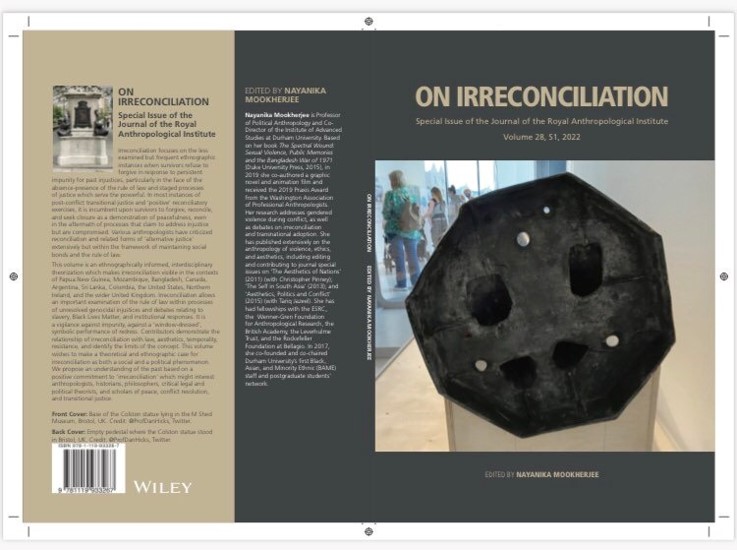
My edited book is On Irreconciliation (2022, exploring non-forgiveness in the face of injustice in post-conflict contexts) and the concept of irreconciliation has been taken up across social science and humanities and among scholars of mental health, climate change, repair, adoption and other fields. I was invited to deliver the 2023 Raymond Firth lecture on this theme at the ASA (Association of Social Anthropology of UK) annual conference. I am currently exploring irreconciliation in the context of Bangladesh and continuing my research on transnational adoption and conflict (funded by British Academy).
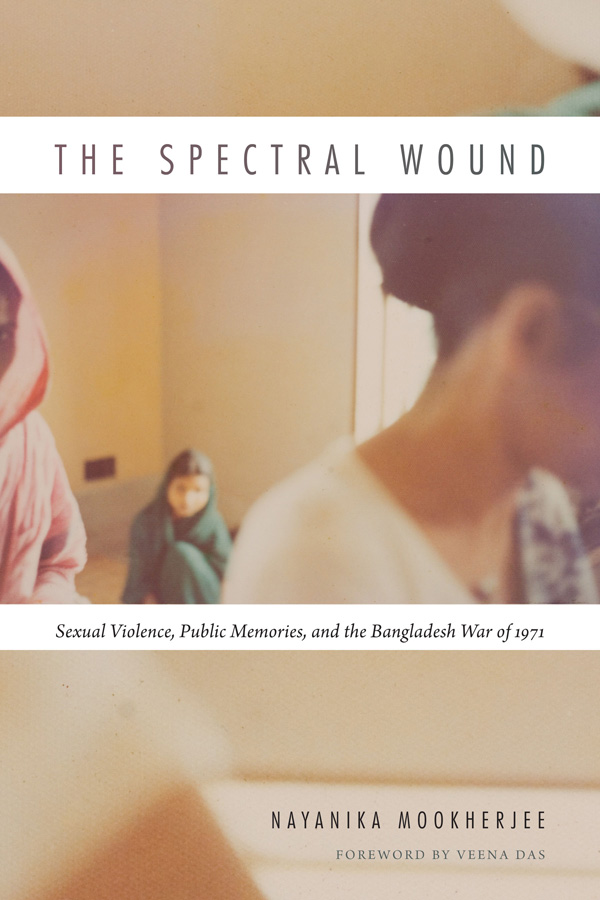
My book The Spectral Wound: Sexual Violence, Public Memories and the Bangladesh War of 1971 (2015 Duke University Press, funded by Wenner Gren, foreword by Veena Das and endorsements by Afsan Chowdhury, Jonathan Spencer and Gayatri Spivak), has been widely-reviewed and acclaimed as well as being shortlisted for awards, generating interviews on Radio 4’s Thinking Allowed along with various academic and media reviews and honours (finalist BBC’s Thinking Allowed Ethnography Award, American Anthropological Association’s Michelle Z. Rosaldo award). Here are a few chosen reviews of the book:
- Acutely aware of the methodological and ethical quandaries of attempts to recover or give voice to survivors, Mookherjee offers instead ethnographic accounts of her birangona interlocutors’ everyday worlds as she encountered them. She juxtaposes these to a reading of testimonial cultures that have developed around the figure of the birangona; critical analysis of visual and literary representations; and conversations with a range of activists, including those responsible for “rehabilitating” so-called war-affected women and girls. This is multi-sited ethnography at its best. – Dina Siddiqi, International Feminist Journal of Politics.
- "[Mookherjee] asks, ‘What would it mean for the politics of identifying wartime rape if we were to highlight how the raped woman folds the experience of sexual violence into her daily socialities, rather than identifying her as a horrific wound?’ That is the central question of this powerful and perceptive book." — Michael Lambek, Journal of Royal Anthropological Institute
- "Mookerjee's exemplary and closely argued The Spectral Wound highlights the central conundrum of making wartime rapes public: heroism, implied and acknowledged by the designation birangona, can only be acquired by making your shame public....[An] uncommonly complex and delicately observed study..." — Ritu Menon, Women's Review of Book
Apart from publishing numerous articles in peer reviewed journals and edited volumes I have co-edited volumes: ‘The Aesthetics of Nation’ (2011 with Christopher Pinney); Aesthetics, Politics and Conflict (2015 with Tariq Jazeel) and edited ‘The Self in South Asia,’ (2013). I have been awarded numerous grants and fellowships by Leverhulme trust, ESRC, British Academy, British Museum and Bellagio Rockefeller Foundation.
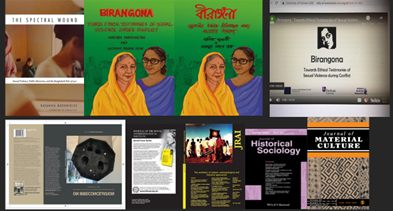
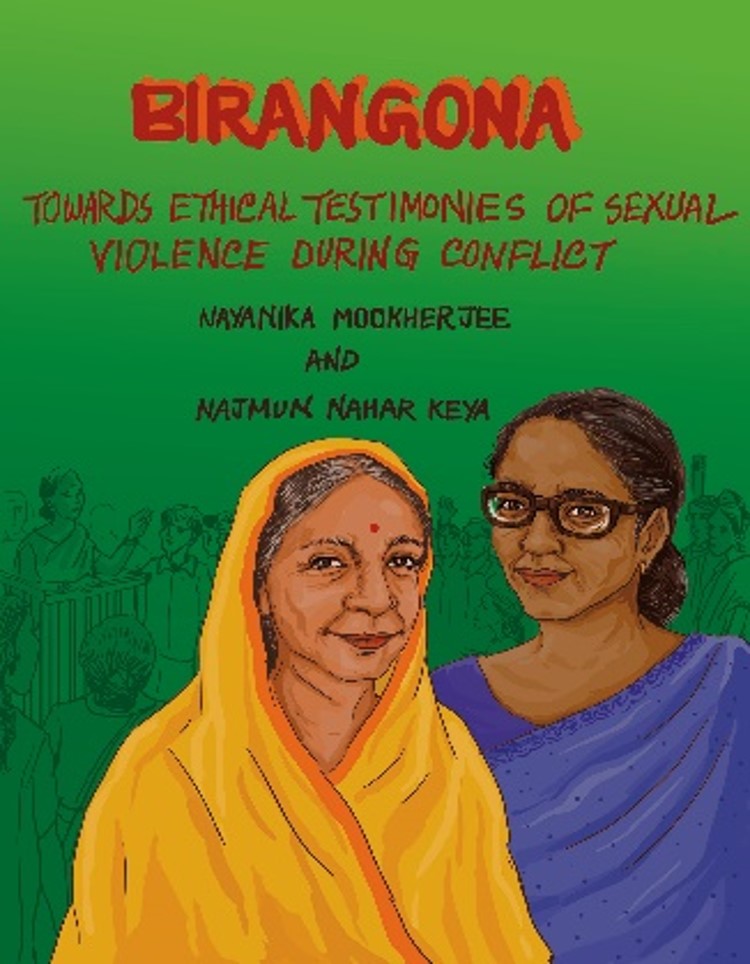
I have pioneered collaborative, arts-based methods (which is on the rise in anthropology) by co-authoring a graphic novel and animation film on ethical testimonies of wartime sexual violence (Birangona 2019; see www.ethical-testimonies-svc.org.uk for access) with a Bangladeshi graphic artist Najmunnahar Keya, based on my book Spectral Wound and received the 2019 Praxis award. Drawing on my research on memorialisation, I am co-leading a project on Absence-Presence of Durham’s Black History and have co-developed an audio walking tour and map in Durham Cathedral and city to explore the relationship between Durham’s history of enslavement, mining and imperialism (Durham Cathedral & City Centre | Durham University). Listen to a podcast on this project.
I have also contributed to a publicly engaged anthropology through a panel on ‘On what does the Future Hold’ (with Dr Michael Crawley, Dr Felix Ringel chaired by Professor Simone Abram) on New Writing North as part of Durham Book Festival 2023. Following a specially commissioned podcast series.
In 2017, I co-set up and co-chaired Durham University’s first BAME (Black Asian and Minority Ethnic) Network for staff and postgraduate students.
I have extensive ethical expertise: currently as Chair of the Ethics Committee in Anthropology in Durham; was part of the executive committee on Ethics of the World Council of Anthropological Association (WCAA); as the ethics officer of ASA (Association of Social Anthropology of UK) she updated the ASA ethics code which is used by anthropologists and social scientists worldwide.
I have mentored numerous early career researchers, have secured funding for postdoctoral fellows (by ESRC, British Academy/Leverhulme). I have successfully examined 13 Phd students, co-supervised 13 PhD students to completion (funded by ESRC, DDS, Wolfson, Commonwealth scholarship) and 10 have gone on to gain permanent academic positions or competitive postdocs.
Research interests
- (i) public memories of wartime sexual violence;
- (ii) the role of graphic ethnography in translating difficult stories;
- (iii) war crimes tribunals and irreconciliation;
- (iv) memorialisation of past violence and the history of the enslaved;
- (v) digital surveillance;
- (vi) transnational adoption and genetic citizenship;
- (vii) ethics;
- (viii) South Asia
Publications
Authored book
- Birangona: towards ethical testimonies of sexual violence during conflictMookherjee, N., & Keya, N. (2019). Birangona: towards ethical testimonies of sexual violence during conflict. Durham University. https://doi.org/10.15128/r1sb3978287
- The Spectral Wound: Sexual Violence, Public Memories and the Bangladesh War of 1971Mookherjee, N. (2015). The Spectral Wound: Sexual Violence, Public Memories and the Bangladesh War of 1971. Duke University Press.
Book review
- 1971: A Global History of the Creation of BangladeshMookherjee, N. (2015). 1971: A Global History of the Creation of Bangladesh. Pacific Affairs, 88(4), 952-955.
- Social Memory and History: Anthropological Perspectives.Mookherjee, N. (2006). Social Memory and History: Anthropological Perspectives. Journal of Royal Anthropological Institute (JRAI), 12, 957-958.
- Violence and Subjectivity.Mookherjee, N. (2000). Violence and Subjectivity. Journal of the Royal Anthropological Institute, 7(4), 793-794. https://doi.org/10.1111/1467-9655.00091
Chapter in book
- 1971: Pakistan's Past and Knowing What Not to NarrateMookherjee, N. (2023). 1971: Pakistan’s Past and Knowing What Not to Narrate. In A. Ali & K. Asdar Ali (Eds.), Towards People’s Histories in Pakistan: In(Audible) Voices, Forgotten Pasts. (pp. 79-94). Bloomsbury Academic.
- Imaging ‘Traitors’: The raped woman and sexual violence during the Bangladesh war of 1971Mookherjee, N. (2022). Imaging ‘Traitors’: The raped woman and sexual violence during the Bangladesh war of 1971. In S. Federman & R. Niezen (Eds.), Narratives of Mass Atrocity: Victims and Perpetrators in the Aftermath (pp. 222-246). Cambridge University Press. https://doi.org/10.1017/9781009110693.010
- Birangona: Towards Ethical Testimonies of Sexual Violence During ConflictMookherjee, N. (2022). Birangona: Towards Ethical Testimonies of Sexual Violence During Conflict. In T. Redding & C. Cheney (Eds.), Profiles in Anthropological Praxis: An International Casebook (pp. 224-235). Berghan.
- Democracy in Scare Quotes: The Granularity of Control in the Hybrid State of BangladeshLacy, M., & Mookherjee, N. (2022). Democracy in Scare Quotes: The Granularity of Control in the Hybrid State of Bangladesh. In A. Ruud & M. Hasan (Eds.), Masks of authoritarianism: Hegemony, power and public life in Bangladesh (1st ed., pp. 237-246). Palgrave Macmillan. https://doi.org/10.1007/978-981-16-4314-9_16
- Graphic Ethnography and Generative Resilience of Sexual Violence in Conflict of the Birangonas (War-heroines) in BangladeshMookherjee, N. (2021). Graphic Ethnography and Generative Resilience of Sexual Violence in Conflict of the Birangonas (War-heroines) in Bangladesh. In J. Clark & M. Ungar (Eds.), Resilience, Adaptive Peacebuilding and Transitional Justice: How Societies Recover after Collective Violence. Cambridge University Press. https://doi.org/10.1017/9781108919500.007
- ‘Memory’Mookherjee, N. (2018). ‘Memory’. In R. Bleiker (Ed.), Visual global politics. Routledge.
- Desh: the aesthetics of staging the nationMookherjee, N. (2016). Desh: the aesthetics of staging the nation. In K. Ashraf (Ed.), Locations : an anthropology of architecture and urbanism. (pp. 12-21). ORO Editions and Bengal Foundation.
- ‘Forced Pregnancy’, humanitarian access to reproductive rights and locating ‘life’ within the powers of ‘death’Mookherjee, N. (2015). ‘Forced Pregnancy’, humanitarian access to reproductive rights and locating ‘life’ within the powers of ‘death’. In V. Das & C. Han (Eds.), Living and dying in the contemporary world : a compendium. (pp. 130-142). California University Press.
- In pursuit of the ‘authentic’ Bengali: Impressions and observations of a Contested DiasporaMookherjee, N. (2014). In pursuit of the ‘authentic’ Bengali: Impressions and observations of a Contested Diaspora. In M. N. Chakraborty (Ed.), Being Bengali : at home and in the world. (pp. 140-158). Routledge.
- Twenty-first century ethics for audited anthropologists.Mookherjee, N. (2012). Twenty-first century ethics for audited anthropologists. In R. Fardon, J. Gledhill, O. (decd) Harris, T. Marchand, M. Nuttall, C. Shore, V. Strang, & R. Wilson (Eds.), Sage Handbook of Social Anhropology (pp. 130-140.). Published with the Association of Social Anthropologists of the United Kingdom and Commonwealth.
- Available motherhood: Legal technologies, ‘state of exception’ and the dekinning of ‘war babies’ in Bangladesh.Mookherjee, N. (2009). Available motherhood: Legal technologies, ‘state of exception’ and the dekinning of ‘war babies’ in Bangladesh. In S. Berking & M. Zolkos (Eds.), Between Life and Death: Governing Populations in an Era of Human Rights. (pp. 267-283). Peter Lang.
- Denunciatory Practices and the constitutive role of Collaboration of the Bangladesh War.Mookherjee, N. (2009). Denunciatory Practices and the constitutive role of Collaboration of the Bangladesh War. In T. Kelly & S. Thiranagama (Eds.), Treason and the Art of Politics: Anthropological and Historical Perspectives. (pp. 48-67). Philadelphia: Pennsylvania University Press.
- ‘Friendships and ethnographic‘ encounters within left-liberal politics in Bangladesh’Mookherjee, N. (2008). ‘Friendships and ethnographic‘ encounters within left-liberal politics in Bangladesh’. In H. Armbruster & A. Laerke (Eds.), Taking Sides: Politics and Ethnography. (A Nancy Lindisfarne Fetschcrift). (pp. 65-87). Berghahn Journals.
- Muktir Gaan (Songs of Freedom), the Raped Woman and the Migrant Identities of the Bangladesh War.Mookherjee, N. (2006). Muktir Gaan (Songs of Freedom), the Raped Woman and the Migrant Identities of the Bangladesh War. In N. Behera (Ed.), Gender, Conflict and Migration. (as part of the Gender and Migration in Asia (pp. 72-96). Sage: New Delhi.
- ‘My man (honour) is lost but I still have my iman (principle)’: Sexual Violence and Articulations of Masculinity.Mookherjee, N. (2004). ‘My man (honour) is lost but I still have my iman (principle)’: Sexual Violence and Articulations of Masculinity. In R. Chopra, C. Osella, & F. Osella (Eds.), South Asian Masculinities (pp. 131-159). New Delhi: Kali for Women.
- ‘The Great Indian Novel’ and ‘Ranajit Guha’.Mookherjee, N. (2004). ‘The Great Indian Novel’ and ‘Ranajit Guha’. In J. Sanga (Ed.), South Asian Literature in English: An Encyclopaedia (pp. 120-125). Connecticut: Greenwood Publishing Group, Inc.:
- Gendered Embodiments: Mapping the body-politic of the raped woman and the nation in Bangladesh.Mookherjee, N. (2003). Gendered Embodiments: Mapping the body-politic of the raped woman and the nation in Bangladesh. In N. Puwar & P. Raghuram (Eds.), Critical Reflections on Gender and the South Asian Diaspora. (pp. 157-177). Berg.
Edited book
- On IrreconciliationMookherjee, N. (Ed.). (2022). On Irreconciliation. Wiley.
Journal Article
- The presence of abandonment: Left to live at the borderland of LampedusaCorso, A., & Mookherjee, N. (2024). The presence of abandonment: Left to live at the borderland of Lampedusa. American Anthropologist, 126(4), 622-634. https://doi.org/10.1111/aman.28016
- ‘Occupying’ the womb: Disrupted kinship futures and sovereign logics in sexual violence during warsMookherjee, N. (2023). ‘Occupying’ the womb: Disrupted kinship futures and sovereign logics in sexual violence during wars. Critique of Anthropology, 43(4), 422-443. https://doi.org/10.1177/0308275X231216250
- Comics as a Tool for Research on Gender Violence. Interview with Nayanika Mookherjee on the Graphic Novel Birangona. Towards Ethical Testimonies of Sexual Violence during Conflict (2019)Mandolini, N., & Mookherjee, N. (2022). Comics as a Tool for Research on Gender Violence. Interview with Nayanika Mookherjee on the Graphic Novel Birangona. Towards Ethical Testimonies of Sexual Violence during Conflict (2019). Vista, 10, Article e022011. https://doi.org/10.21814/vista.4109
- Moments of Lightheartedness: Graphic Ethnography Unsettling the Weightiness of FieldworkMookherjee, N. (2022). Moments of Lightheartedness: Graphic Ethnography Unsettling the Weightiness of Fieldwork. Cultural Anthropology. Advance online publication.
- Aurality of images in graphic ethnographies: Sexual violence during wars and memories of the feelings of fearMookherjee, N. (2022). Aurality of images in graphic ethnographies: Sexual violence during wars and memories of the feelings of fear. Sociological Review, 70(4), 686-699. https://doi.org/10.1177/00380261221108843
- ‘Medicine in Name Only’: Mistrust and COVID-19 Among the Crowded Rohingya Refugee Camps in BangladeshIslam, S. N. E., Mookherjee, N., & Khan, N. (2022). ‘Medicine in Name Only’: Mistrust and COVID-19 Among the Crowded Rohingya Refugee Camps in Bangladesh. Medicine Anthropology Theory, 9(2), 1-32. https://doi.org/10.17157/mat.9.2.5424
- Irreconcilable timesMookherjee, N. (2022). Irreconcilable times. Journal of the Royal Anthropological Institute, 28(S1), 153-178. https://doi.org/10.1111/1467-9655.13760
- Introduction: On irreconciliationMookherjee, N. (2022). Introduction: On irreconciliation. Journal of the Royal Anthropological Institute, 28(S1), 11-33. https://doi.org/10.1111/1467-9655.13751
- Historicising the Birangona: Interrogating the Politics of Commemorating the Wartime Rape of 1971 in the context of the 50th Anniversary of BangladeshMookherjee, N. (2022). Historicising the Birangona: Interrogating the Politics of Commemorating the Wartime Rape of 1971 in the context of the 50th Anniversary of Bangladesh. Strategic Analysis, 45(6), 588-597. https://doi.org/10.1080/09700161.2021.2009663
- ‘Firing cannons to kill mosquitoes' : Controlling virtual ‘streets’ and the ‘image of the state’ in BangladeshLacy, M., & Mookherjee, N. (2020). ‘Firing cannons to kill mosquitoes’ : Controlling virtual ‘streets’ and the ‘image of the state’ in Bangladesh. Contributions to Indian Sociology, 54(2), 280-305. https://doi.org/10.1177/0069966720917923
- 1971: Pakistan's Past and Knowing What Not to NarrateMookherjee, N. (2019). 1971: Pakistan’s Past and Knowing What Not to Narrate. Comparative Studies of South Asia, Africa and the Middle East, 39(1), 212-222. https://doi.org/10.1215/1089201x-7493909
- Aesthetics, Politics and ConflictJazeel, T., & Mookherjee, N. (2015). Aesthetics, Politics and Conflict. Journal of Material Culture, 20(4), 353-360. https://doi.org/10.1177/1359183515607249
- The raped woman as a horrific sublime and the Bangladesh war of 1971Mookherjee, N. (2015). The raped woman as a horrific sublime and the Bangladesh war of 1971. Journal of Material Culture, 20(4), 379-395. https://doi.org/10.1177/1359183515603742
- The ‘War Heroines’ of Bangladesh: Lessons for fighting sexual violence in conflict in Nabanita Deb SenMookherjee, N. (2015). The ‘War Heroines’ of Bangladesh: Lessons for fighting sexual violence in conflict in Nabanita Deb Sen. Presidency Alumni Association: Autumn Annual, XLIII, 105-107.
- Introduction: The Self in South Asia.Mookherjee, N. (2013). Introduction: The Self in South Asia. Special Issue of The Journal of Historical Sociology, 26.1(Spring 2013), 1-18.
- The absent piece of skin: Gendered, racialized and territorial inscriptions of sexual violence during the Bangladesh warMookherjee, N. (2012). The absent piece of skin: Gendered, racialized and territorial inscriptions of sexual violence during the Bangladesh war. Modern Asian Studies, 46(6), 1572-1601. https://doi.org/10.1017/s0026749x11000783
- Reproductive Heteronormativity and Sexual Violence in the Bangladesh War of 1971: Discussion with Prof. Gayatri Chakravorty Spivak.Mookherjee, N. (2012). Reproductive Heteronormativity and Sexual Violence in the Bangladesh War of 1971: Discussion with Prof. Gayatri Chakravorty Spivak. Social Text, 30(2), 123-131. https://doi.org/10.1215/01642472-1541790
- Introduction: ‘The Aesthetics of nations: Anthropological and historical approaches’Mookherjee, N. (2011). Introduction: ‘The Aesthetics of nations: Anthropological and historical approaches’. Journal of the Royal Anthropological Institute, 17(Supplement, s1), 1-20. https://doi.org/10.1111/j.1467-9655.2011.01686.x
- ‘Never Again’: Aesthetics of ‘Genocidal’ Cosmopolitanism
and the Bangladesh Liberation War Museum.Mookherjee, N. (2011). ‘Never Again’: Aesthetics of ‘Genocidal’ Cosmopolitanismand the Bangladesh Liberation War Museum. Journal of the Royal Anthropological Institute, 17(S1), 71-91. https://doi.org/10.1111/j.1467-9655.2011.01690.x
- Mobilising Images: Encounters of ‘Forced’ Migrants and the
Bangladesh war of 1971.Mookherjee, N. (2011). Mobilising Images: Encounters of ‘Forced’ Migrants and theBangladesh war of 1971. Mobilities, 6(3), 399-414. https://doi.org/10.1080/17450101.2011.590037
- Love in the time of 71: The Furore over Meherjaan.Mookherjee, N. (2011). Love in the time of 71: The Furore over Meherjaan. Economic and Political Weekly., Vol. 46(No. 12 March 19 - March 25, 2011:), 25-27.
- Discussion point: when informants lie.Mookherjee, N., Long, N., & Bruner, E. (2010). Discussion point: when informants lie. Cambridge Anthropology: 800th Anniversary Commemorative Volume, 29(3), 85-94.
- Ethical murkiness of research on commemorative practices of past historical injustices: Response to Sue Benson’s ‘They came from the North: Historical truth and the duties of memory along Ghana’s slave route.’Mookherjee, N. (2010). Ethical murkiness of research on commemorative practices of past historical injustices: Response to Sue Benson’s ‘They came from the North: Historical truth and the duties of memory along Ghana’s slave route.’. Cambridge Anthropology. 800th Anniversary Commemorative Volume, 29(3), 88-94.
- The Ethics of Apology: A Set of CommentariesMookherjee, N., Rapport, N., Josephides, L., Hage, G., Todd, L. R., & Cowlishaw, G. (2009). The Ethics of Apology: A Set of Commentaries. Critique of Anthropology, 29(3), 345-366. https://doi.org/10.1177/0308275x09336703
- The Ethics of Apology Open Meeting at the joint international conference of the ASA, the ASAANZ and the AAS, Auckland, 9 December 2008.Mookherjee, N. (2009). The Ethics of Apology Open Meeting at the joint international conference of the ASA, the ASAANZ and the AAS, Auckland, 9 December 2008. Anthropology Today, 25(3).
- Debates on Ethical Practice: A Perspective from the Association of Social Anthropologists.Mookherjee, N., & Harper, I. (2009). Debates on Ethical Practice: A Perspective from the Association of Social Anthropologists. Anthropology News, 50(6), 10-11.
- Gendered Embodiments: Mapping the body-politic of the raped woman and the nation in Bangladesh.Mookherjee, N. (2008). Gendered Embodiments: Mapping the body-politic of the raped woman and the nation in Bangladesh. Feminist Review, Special Issue on War, 88(1), 36-53.
- Culinary boundaries and the making of place in Bangladesh.Mookherjee, N. (2008). Culinary boundaries and the making of place in Bangladesh. South Asia: Journal of South Asian Studies, 31(1), 56-75. https://doi.org/10.1080/00856400701874718
- Available motherhood: Legal technologies, ‘state of exception’ and the dekinning of ‘war babies’ in Bangladesh.Mookherjee, N. (2007). Available motherhood: Legal technologies, ‘state of exception’ and the dekinning of ‘war babies’ in Bangladesh. Childhood, 14(3), 339-354. https://doi.org/10.1177/0907568207079213
- The “Dead and their Double Duties”: Mourning, Melancholia and the Martyred Intellectual Memorials in Bangladesh. Special Issue The Material and Visual Culture of Cities.Mookherjee, N. (2007). The “Dead and their Double Duties”: Mourning, Melancholia and the Martyred Intellectual Memorials in Bangladesh. Special Issue The Material and Visual Culture of Cities. Space and Culture, 10(2), 271-291.TranslatedinSinhalaandTamil.
- ‘Research’ on Bangladesh War.Mookherjee, N. (2007). ‘Research’ on Bangladesh War. Economic and Political Weekly., 42(50), 118-121.
- Bangladesh war of 1971: A Prescription for Reconciliation?Mookherjee, N. (2006). Bangladesh war of 1971: A Prescription for Reconciliation? Economic and Political Weekly., 41(36), 3901-3903.
- Remembering to Forget: Public Secrecy and Memory of Sexual Violence in Bangladesh.Mookherjee, N. (2006). Remembering to Forget: Public Secrecy and Memory of Sexual Violence in Bangladesh. Journal of Royal Anthropological Institute (JRAI), 12(2), 433-450.
- Dressed for Fieldwork: Sartorial Borders and Negotiations.Mookherjee, N. (2001). Dressed for Fieldwork: Sartorial Borders and Negotiations. Anthropology Matters, 3(1).
- Ethical Issues Concerning Representation of Narratives of Sexual Violence.Mookherjee, N. (n.d.). Ethical Issues Concerning Representation of Narratives of Sexual Violence. Drishtipat: Women and War – Activist Website Seeking to Raise Funds for War- Affected Women of 1971.. Advance online publication
Newspaper/Magazine Article
- Can the Student Uprisings in New Delhi and Bangladesh Foster a New South Asian Solidarity?Mookherjee, N. (2026, August 26). Can the Student Uprisings in New Delhi and Bangladesh Foster a New South Asian Solidarity? The Wire.
- July and its neighbourly uprisingsMookherjee, N. (2026, August 22). July and its neighbourly uprisings. New Age.
- 2026 Bangladeshi Elections and Information BombsMookherjee, N. (2026, January 12). 2026 Bangladeshi Elections and Information Bombs. Counterpoint.
- This account of the Bangladesh war should not be seen as unbiased.Mookherjee, N. (2011, June). This account of the Bangladesh war should not be seen as unbiased. The Guardian.
Other (Digital/Visual Media)
- Birangona: Towards Ethical Testimonies of Sexual Violence during Conflict (Animation Film)Mookherjee, N., & Keya, N. (2019). Birangona: Towards Ethical Testimonies of Sexual Violence during Conflict (Animation Film). https://doi.org/10.15128/r1jq085k00x
Other (Print)
- History and the Birangona: The ethics of representing narratives of sexual violence of the 1971 Bangladesh warMookherjee, N. (2015). History and the Birangona: The ethics of representing narratives of sexual violence of the 1971 Bangladesh war. HIMAL Southasian.
- The 'war heroines' of Bangladesh: lessons for fighting sexual violence in conflict.Mookherjee, N. (2014). The ’war heroines’ of Bangladesh: lessons for fighting sexual violence in conflict. The Conversations.
- There is a need to avoid appropriation and exacerbation of their sufferings.Mookherjee, N. (2010). There is a need to avoid appropriation and exacerbation of their sufferings. New Age Xtra.