

/filters:quality(70)/prod01/prodbucket01/media/durham-university/alumni-/about-us-/About-Us-Banner.png)
- Short explanation history.
My academic career spans two periods: (1) - study, academic activity and getting main graduation degrees at the Adam Mickiewicz University in Poznań since 1950 – 1970 and (2) - continuation of the academic life - work at the Gdańsk University since 1970 (then founded) until now becoming profesor emeritus of the University in 1999.
Working at the University of Adam Mickiewicz in Poznań I got MSc (1952) and the Ph.D (1958) in Physics at the Mathematics, Physics and Chemistry Faculty at the Acoustics and Vibration Theory Department guided by professor Marek Kwiek (my promotor in Ph.D) who had work relations with professor Richard Richardson, widely known scientist in physical acoustics at the University of Durham, King’s College Newcastle. Thanks to the correspondence and recommendations of both I got the British Council scholarship and the invitation for a year post- doctorial stay in the Professor Richardson’s laboratory for 1961/62. Unfortunately, just a few months before my coming to the UK, Prof. Richard Richardson died and I lost my opportunity to work with him personally as we had forseen planning my stay there. Fortunately, my stay had been accepted by Professor Richardson’s co-worker dr Arthur Edgar Brown who became the chief of the laboratory and of the group of acousticiants whom I had joined in October 1961.
It was the time of transformation of the King’s College Newcastle into the new University and foundation of the independent University of Newcastle as the historical budding from the roots of the old Durham University established in 19th century functioned as a long assosiation of two campuses Durham Colleges in Durham and King’s College in Newcastle. Although the formal final separation between two campuses took place in 1963, my stay during the academic year 1961/62 was practically the time of the beginning of „new days of the new University of Newcastle”; the Physics Department got the new building and removed to settle in it and to equip it perfectly. So, I started to work in the new laboratory to perform my experimental research project along next ten months in the New Physics Building.
However, links with Durham still existed. During my stay in Newcastle I attended several lectures and seminars at Durham College, too. My stay in Newcastle was also registered in Durham University as the British Council Scholar (see the scans below) for postgraduate study. I was also registered for the Association of Durham University Alumni and as its member permanently until now I am obtaining regular Bulletin of the Association reading much information and contacting online sometimes. I feel proud to belong to the Durham University Alumni association for so long and I am glad the Durham University Team wants me to add a few words about my small contribution to the history of the Durham.
- Some events that happened during the stay at the King’s College Newcastle in 1961/62
In a few days after I joined the Acoustics Group in the New Physics Building at King’s College Newcastle the plan of my research project was discussed with Dr A. E. Brown, accepted by him as well as by Professor S. K. Runcorn the Director of the Physics Department and I started work there. The field of study was the experimental observation and measurements of fluctuation in ultrasonics – light diffraction patterns near the thermodynamical critical point in ethelene. I spent a lot of time in the laboratory to prepare the experimental stand and partly to build up apparatus to perform observations and measurements, finally collecting data of original results. Dr Brown, who supervised and helped me to realize my research project after ten months wrote in his summerizing opinion: „There were a great many technical difficulties to be overcome in the design and constraction of apparatus and in conduct of the experiments. Even so, Dr Śliwiński has obtained many interesting and significant results in the short time he has spent here”. Later, the results were published and also in the future used in my habilitation (D.Sc.graduation at Poznań University, 1964).
The most important event I attended during my stay in Newcastle was the oficial celebration of the Opening of the New Physics Building at King’s College Newcastle in March 1962. The impressive meeting of physicists with technologists and other science and industry representatives was organized on the occasion. The participants could hear seven key lectures presented by eminent persons: two Nobel Price winners: P. M.S. Blackket and J. Cocroft and five well known authorities: L. Rosenfeld, C.J. Gorter, F. Hoyle, Z. D. Garland, R. E Peierls. The conference awoke a wide international interest. The seven lecures were published in the book (Runcorn S. K., Editor, 1963) and later translated into a Polish edition (S. K. Runcorn., Majewski Z., Translator,1966). It was a nice surprise for me one day in the sixties to find the Polish edition of Professor Runcorn’s book in the library.
During the stay it was possible to arrange various excursions to visit acoustic groups of few academic centres situated at the following places: Imperial College, London; Clarendon Laboratory, Oxford; Cavendish Laboratory, Cambridge; University of Liverpool as well as National Laboratory, Tedington and British Broadcasting Corporation, Kingswood. I met many interesting people there and acquired very valuable experience for my future academic activity.
Also, mainly during weekends I participated in some sport events like International Evening Arrranged by Gatehead Rotary Club in March 1962, or tourist sightseeing excursions all over Northumberland often organized by the Area Office of British Council Newcastle under kind care of the Assistant Mrs M. L. Gunn.
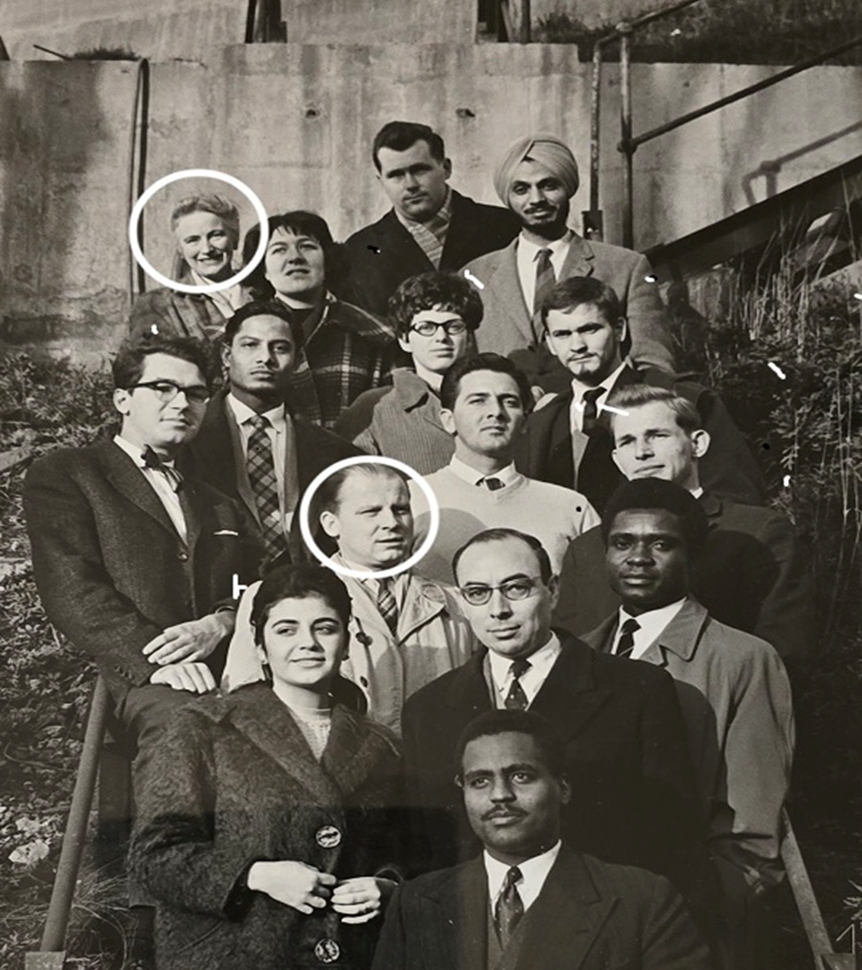
The image above shows the Newcastle’s group of British Council Scholars during the excursion around Northumberland, 1962; in upper left circle: Mrs M. L.Gunn Assistant of BC area; in middle circle A.S. Śliwiński (the author, Poland).
- The influence of the stay on the future international cooperation
My educational and research experiece I obtained during my stay at Durham University , Kings College Newcastle had an important influence on my academic activity in my future life . Thanks to many contacts I could make in the UK a good cooperation with many acoustics groups at academic institutions were established and continued for many years.
I shall only mention institutions which used to have a more or less permanent scientific links during my long academic work. They are as follows: King’s College Newcastle Dr A. E. Brown until he retired; died in 2018) ; Imperial College, London (Prof. R.W. B. Stephens until he died in 1980-ties.); Chelsea College, London (Dr G. Leventhall - last time we met in Warsaw in 2018); University of Surrey; Prof. R.Chievers, died in 2004), Aberdeen University (prof. R. V. Jones, Dr J. Reid, I spent 3 weeks research visit in the Physics Department there in 1979); Aberdeen Technical College ( Dr I. B.Lockie - my good friend since our common work in the same roon in Acoustics Lab. at King’s College Newcastle in 1961 -1962 just making measurements for his future doctor thesis which took place in Aberdeen, he died in 2023); University of Keele. The cooperation of these institutions was alive and efficient. The scientists from both sides attended many conferences in the UK as well as in Poland.
Among many international journals, for many years I continued the editorial and referie duties being the member of Editorial Boards of the British journals: Ultrasonics and Acoustics Letters. During my long international activity I was honoured to share participation with many British physicists and acousticians in various International Bodies, like Boards of ICA (International Comission on Acoustics) elected for a few cadences, Conference Organizing Commitees and many other international cooperating acoustics groups and institutions.
I was quite amazed when accidentally I visited my page in Wikipedia how it was possible to achieve so much during my life.
4. Final remarks
As I wrote at the beginning I joined the association of the Durham University Alumni in 1961 being its member permanently until now which means 65 years. I am now a man of nearly 98 years old. However, I am still in good enough condition to remember many facts of my stay in Newcastle.
so I decided to accept the invitation of Durham University Alumni Engagement Team to write some reminiscences. The statement: „your story is part of the Durham story” in their invitation appeal to act as the King’s College alumnus to prepare some historical facts related to my case convinced me on that. I realized. that my post-doctoral stay at King’ College Newcastle in the acad. year 1961/62 is a part of the Durham University history, though it was the time of the origin of the University of Newcastle (formally founded in 1963). So, I made up my mind to write some words of reference to that.
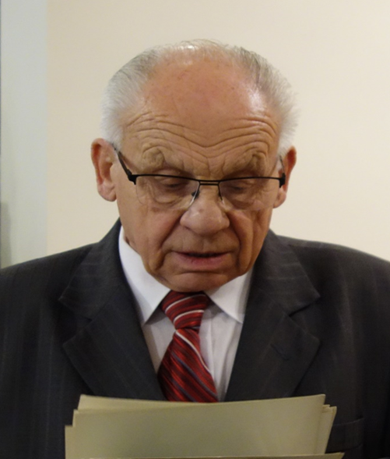
^ Antoni Śliwiński, 2024
I hope that with my small contribution to the history of the Durham University I expressed my gratitude to Durham University for hosting me during my post doc study and for all the good I got from Durham and Newcastle communities, then and later in my academic carrier evidently influenced by the experience I have acquired.
I feel proud to belong to the Durham University Alumni association for so long and I am glad the Durham University Alumni Team gave me the opportunity to add a few words about my stay in King’s College Newcastle to the history of the Durham University.
Physics, 1959 - 1962