/filters:quality(70)/prod01/prodbucket01/media/durham-university/alumni-/about-us-/About-Us-Banner.png)
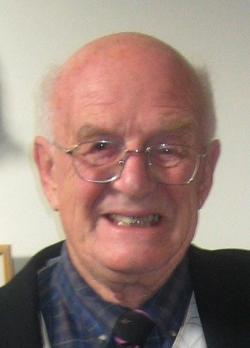
Robert "Geoffrey" Chaytor
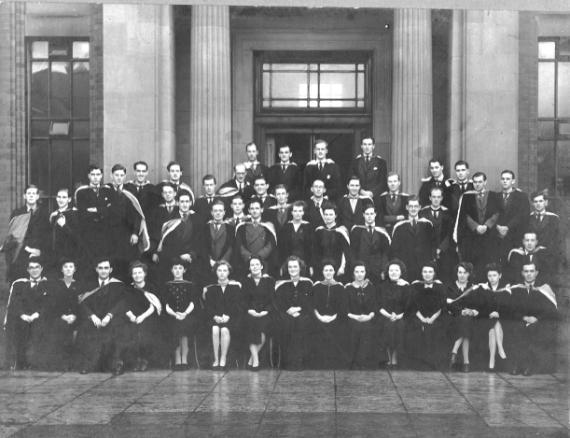
I am a 98 year old retired ENT consultant. Just as war was declared in n1939 I went up to King's College Medical School. Entry was on one's school certificate results plus interview. Because the majority of schools providing undergraduates were then unisex with boy's schools not taking Botany and girl's tending not to do Chemistry, most entrants had to take a year doing pre-med (Chemistry; Physics; Botany; Zoology). This made the course 6 years, but in 1940 it was decided to cancel all vacations and my year graduated in December 1944, rather than June 1945. We were automatically called up for military service after making the requirements for entry to the Medical Register.
War had been on the cards for some months and I suspect that, because of it, students had applied to the nearest University and the majority in my year travelled from home each day. I came in by bus from Ashington where my Dad was Head of a school.
We immediately went on to a rota for Fire Watching. We were on duty from early evening until breakfast that was provided free and we were given a small remuneration as well. The first night that I did this I spent in the basement of the Medical School and woke up with the floor swarming with cockroaches. After that I took my camp-bed to one of the upper floors. My team were, actually, never on duty when there was a raid. As the war progressed staffing in hospitals became difficult and more senior medical students were sent to undertake 'house jobs'. I spent Christmas/New Year (1943/44) working at Newcastle General Hospital.
I could say something about the NGH. It has been a Workhouse and was owned by the City Council. The Royal Victoria Infirmary was the main general hospital. Consultants there (before the NHS) were unpaid and honorary. Those who were unable to find accommodation there could ask the City Council for space at the NGH, where money seemed to be no problem. Mr George Rowbotham headed a fine Neurosurgical Dept. Dr George Davison a paediatric Dept, Dr Dorothy Kerslake a midwifery/Gynaecology Dept etc. I worked in Mr Wardill's Prostate Unitt. To give you some idea of the staff shortage, the following would have given Health and Safety a field day. On Wednesday mornings, George Rowbotham did a long operation starting very early. A well known Consultant Anaesthetist, anaesthetised this patient and left him/her in the care of a capable but more junior anaesthetists. He then come to D block, Mr Wardill's ward and put it a spinal anaesthetic for 2/3 patients who were going to have a prostrate operation. They were left in the care of Mr Potter the Assistant Consultant. He then came over to the main building where Mr Clay, who had been in the Boer War and who had been brought out of retirement under took a general operating list where it was necessary for the anaesthetist to be permanently present. Between cases he checked on the other two operating sessions!
In the Journal this week there has been a photograph of the original Workhouse that was the Staff Dining Room when I know it and which is about to be demolished.
For a short time after D Day normal studies came to a halt as one was sent out to emergency hospitals. Two of us went to Relton Emergency Hospital in Chester-le-street. Late on evening a train load of casualties were unloaded from a siding to this hospital. Nearly all had malaria. It is not generally known that many of the troops stuck in the south of England before D Day had seen service in North Africa, Italy tec and had Malaria. The hot weather in the swampy terrain there brought on a recurrence. I had 2 wards all with Malaria. It was useful in my finals because I learned a lot about prescribing.
Medicine, 1939 - 1944