

/filters:quality(70)/prod01/prodbucket01/media/durham-university/departments-/physics/teaching-labs/VT2A9034.jpeg)
Professor Simon Cornish elected Fellow of the American Physical Society

Professor Simon Cornish, from our Department of Physics, has been elected a Fellow of the American Physical Society (APS) in recognition of his pioneering research into ultracold quantum matter.
A prestigious honour
APS Fellowship is a prestigious honour recognising exceptional achievements in physics through research, teaching, innovation or service.
Each year, no more than 0.5% of the Society membership, excluding student members, is recognised by their peers for election to Fellow of the American Physical Society.
Simon’s official APS citation reads:
“For pioneering advances in ultracold quantum matter, including control of interactions via Feshbach resonances, the creation of bright matter-wave solitons, and contributions to ultracold polar molecules, enabling quantum simulation and quantum information science.”
Simon is Head of Quantum, Light and Matter at Durham and is project lead for UKRI-funded national research programme investigating quantum simulation with ultracold molecules (QSMol).
At the forefront of quantum physics
Simon’s research focuses on ultracold atoms and molecules, quantum simulation, precision measurement and Bose–Einstein condensation.
His team studies atoms and molecules at temperatures within a millionth of a degree of absolute zero.
He leads an experimental group exploring the distinctive properties of ultracold polar molecules and their potential applications across quantum science.
His work could open new possibilities for quantum computing and for simulating complex quantum systems.
World-leading quantum entanglement
A Durham research team led by Simon recently achieved world-leading quantum entanglement of individual molecules held in optical tweezers.
The breakthrough demonstrated precise control of individual molecules and their interactions, marking progress towards processing quantum information with molecular systems.
These systems could also help researchers investigate and understand exotic phenomena that emerge in systems of many interacting quantum particles – high temperature superconductivity is a prime example.
It is an enormous honour to be recognised by my US colleagues and the American Physical Society in this way. Of course, much of the credit should go to the many talented PhD students and postdocs that I have had the privilege to work with in Durham.
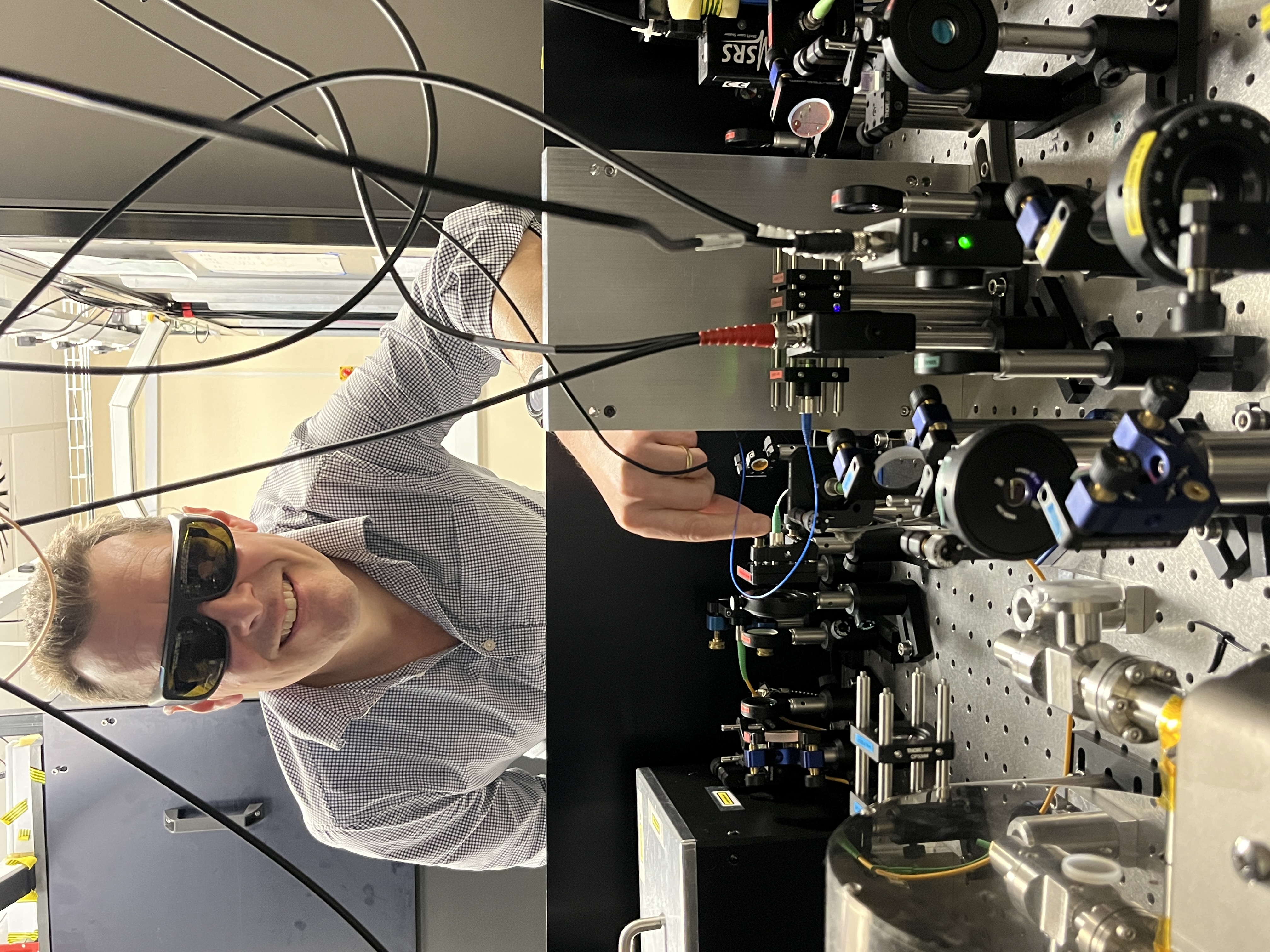
Image caption: Professor Simon Cornish in a Durham University laboratory, where his group uses lasers to trap and manipulate single atoms and molecules.
Find out more
- See the full list of The American Physical Society's 2026 Fellows.
- Discover more about the work of Professor Simon Cornish.
- Learn more about Simon in our Spotlight on.
- Read how our world-class research was showcased during the European Research Council Scientific Council visit and how Durham will lead a new era of quantum science research.
- Read about the most recent quantum entanglement achievement by Professor Cornish and his team, published in Nature.
- Read more about the QSMol programme grant.
- Find out more about the Durham Quantum Light and Matter research group and the Cornish Labs.
- Our Department of Physics is ranked joint 67th in the QS World University Rankings by Subject 2026 and fourth in the UK in the Complete University Guide 2027.
- Visit our Physics webpages for more information on our undergraduate and postgraduate programmes.