

/filters:quality(70)/prod01/prodbucket01/media/durham-university/departments-/faculty-of-science-/general-pictures/71353.jpg)
Want to keep the peace? Try a little tenderness
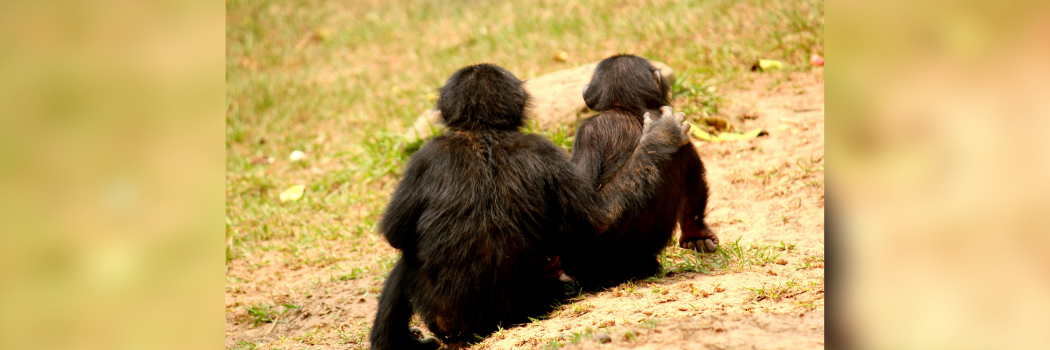
Ever noticed how, in tense situations, people may use reassuring touches to try and calm things down? This could be an evolutionary social tool dating back millions of years.
Well, according to a new study led by our Department of Psychology, this could be an evolutionary social tool dating back millions of years.
The study looked at the behaviours of our closest ape relatives, bonobos and chimpanzees.
The aim – to test whether reassuring physical touch, such as hugging and body kissing, seen in both bonobos and chimpanzees, improved social tolerance.
Keeping the peace
The analysis showed that bonobos and chimpanzees who engaged in reassuring touch before socially-tense events like feeding, went on to spend more time peacefully co-feeding alongside others.
The researchers believe this shows that touch may be a short-term tool to manage social tension and competition and maintain group harmony.
What’s more, the close similarity in the range of reassurance behaviours between both bonobos and chimpanzees suggests a shared evolutionary origin.
In short, it could date back over six million years to humans’ shared lineage with our closest ape relatives.
Calming effect of touch
The study involved 116 semi-wild bonobos and chimpanzees, living in sanctuaries in The Democratic Republic of the Congo and Zambia.
/filters:quality(70)/prod01/prodbucket01/media/durham-university/central-news-and-events-images/Bonobos-and-chimps---gallery-image-1.png)
/filters:quality(70)/prod01/prodbucket01/media/durham-university/central-news-and-events-images/Bonobos-and-chimps-gallery-image-2.png)
/filters:quality(70)/prod01/prodbucket01/media/durham-university/central-news-and-events-images/Bonobos-and-chimps-gallery-image-3.png)
/filters:quality(70)/prod01/prodbucket01/media/durham-university/central-news-and-events-images/Bonobos-and-chimps-gallery-image-4.png)
/filters:quality(70)/prod01/prodbucket01/media/durham-university/central-news-and-events-images/Bonobos-and-chimps-gallery-image-5.png)
Researchers filmed and analysed over 10 hours of footage of reassuring body contact in the minutes before food was released into a shared, restricted space – a setup designed to mimic the social tension of natural feeding competition, such as fruiting trees.
What they found was that, for both bonobos and chimpanzees, more pre-feeding reassurance led to more harmonious co-feeding.
Within bonobos, the strongest effect was seen amongst female-female pairs, consistent with the central role female alliances play in bonobo society.
For chimpanzees, the effect was strongest amongst male-male pairs, reflecting the importance of male bonds in chimpanzee social structure.
The strength of these patterns was clearest in the more socially tolerant groups of both bonobos and chimpanzees, suggesting that strong alliances reinforced by reassurance prior to feeding may function to maintain a tolerant social climate.
Researchers also noted chimpanzees – especially males in more socially tolerant groups – engaging in riskier, trusting behaviours, like putting fingers or hands in each other’s mouths.
We were partly inspired to conduct this study when we observed, early on, in our most tolerant chimpanzee group: one male embracing another from behind, then a second joining in, then a third, one by one, until a whole chain settled — my colleagues and I started calling this the 'reassurance train’.
The results offer a fascinating insight into the evolutionary roots of social touch, and how our ancestors, and we, manage tension, competition and cooperation.

Find out more
- Read the full research paper published in Proceedings of the Royal Society B: Biological Sciences.
- This study was led by Dr Jake Brooker and Professor Zanna Clay. Dr Brooker was based in our Department of Psychology at the time of the research and now works at Utrecht University in The Netherlands. The research team also included academics from universities in Germany, The Netherlands and USA.
- Find out more about the two African great ape sanctuaries where this research took place - Lola ya Bonobo Sanctuary in the Democratic Republic of Congo, and the Chimfunshi Wildlife Orphanage Trust in Zambia.
- The research was funded by the Templeton World Charity Foundation.
- Our Department of Psychology is ranked 70thin the QS World University Rankings by Subject 2026 and tenth in the UK in the Complete University Guide 2027. Visit our Psychology webpages for more information on our undergraduate and postgraduate programmes.