Latest News
Researchers propose first method to detect ‘mirror life’
Scientists have proposed what they believe is the first method for detecting ‘mirror life’ – a hypothetical form of life made from molecular building blocks that are the mirror image of those found naturally on Earth.
New £7m programme grant to reinvent energy storage
What if energy storage could be built directly into the materials that make up everyday products? Our Engineering, Chemistry and Anthropology departments are part of a major new project exploring materials that can combine energy storage and structural performance.

£1.7m grant to uncover the secrets of molecular behaviour using robotic chemistry and AI
Using robotic laboratories and AI, our researchers will study molecular behaviour to develop new chemicals and materials more efficiently, thanks to funding worth £1.7m (€2.1m).
School pupils help discover promising new tuberculosis drug boosters
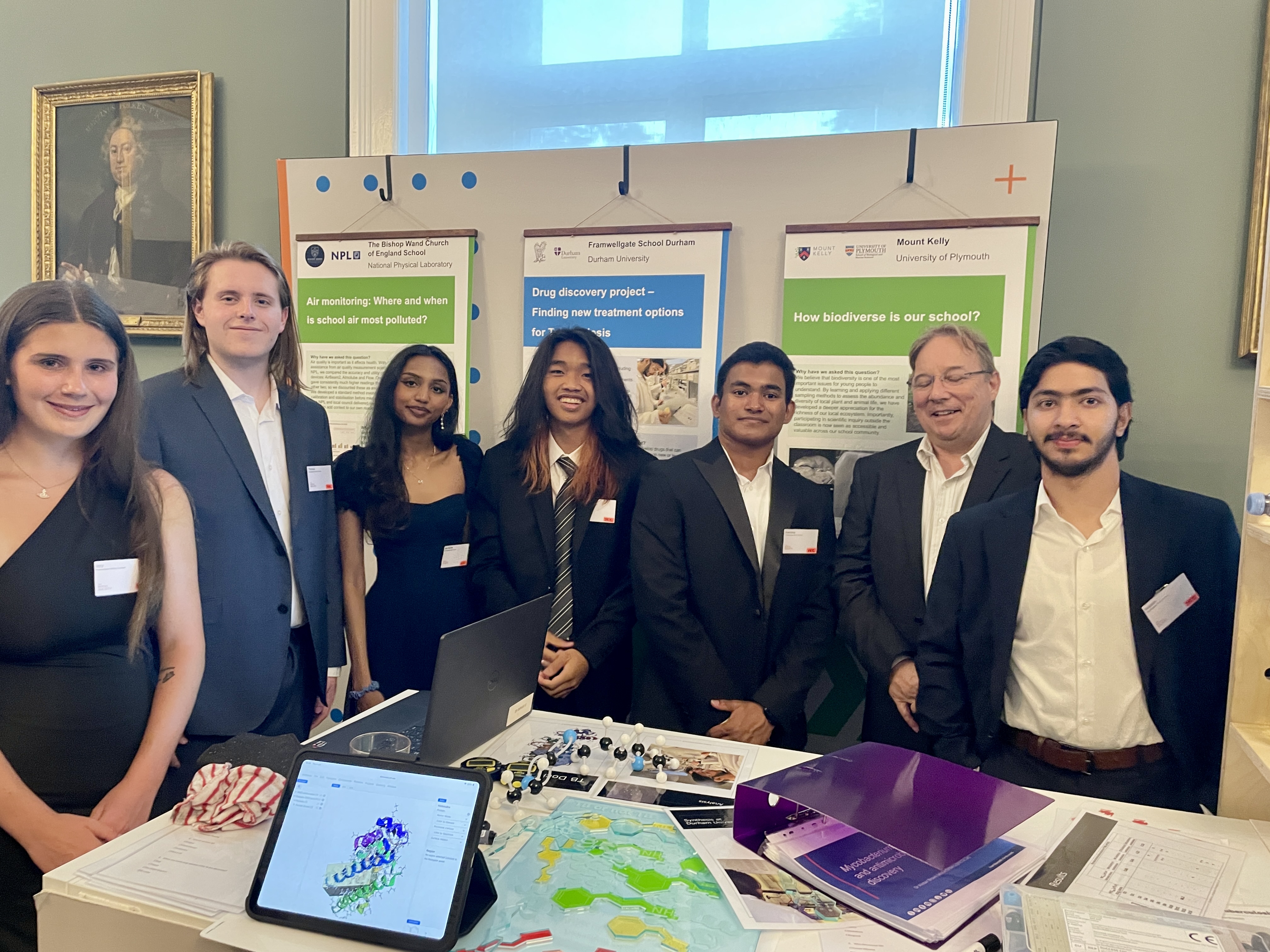
School pupils helped develop and test promising new compounds that could improve the effectiveness of existing tuberculosis (TB) treatments as part of a unique research project.

Chemistry students help design drugs to help fight tuberculosis
This project - partially funded by the Royal Society involved 35 students from four schools in County Durham, St John's Bishop Auckland, Framwellgate School, Durham School and St. Leonards.
Durham researchers recognised with Royal Society of Chemistry Horizon Prize
Researchers from our top-rated Chemistry and Biosciences Departments have been recognised as part of an international team awarded a prestigious 2026 Horizon Prize by the Royal Society of Chemistry (RSC).
Durham spin-out company wins major life sciences award
Nevrargenics, a Durham University spin-out company, has received the Bionow Project of the Year Award at the 2025 Bionow Annual Awards.

Durham leads project to transform medicines, agrochemicals and other crystalline-based consumer products
A Durham-led research project has been awarded a grant from the Engineering and Physical Sciences Research Council (EPSRC) to revolutionise how molecular crystals are designed.

Scientists discover new DNA-binding proteins from extreme environments that could improve disease diagnosis
Researchers from our top-rated Biosciences and Chemistry Departments are leading an international effort to turn discoveries from some of the harshest places on Earth into practical tools for healthcare.

New materials conduct ions in solids as easily as in liquids
We’re part of an international team of scientists behind the creation of a new family of organic materials that can conduct ions - atoms or molecules with a net electrical charge - in solids.
£1.7m funding to enhance student facilities
We’ve been awarded £1.7 million to help deliver courses that will increase opportunities for students and support economic growth.
Chemists discover why sunscreen stains leave you seeing red
Have you ever tried bleaching sunscreen stains on clothing, only to be left with bright red results?